

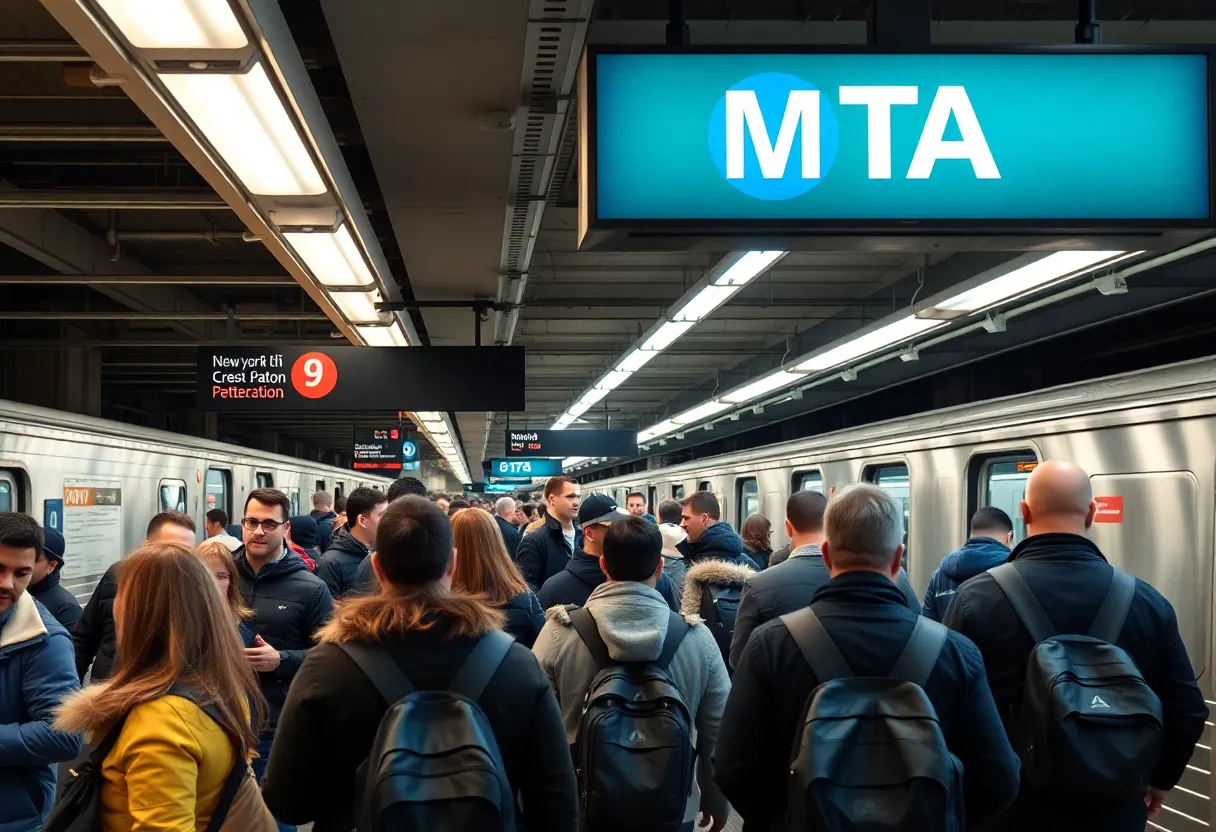
New York City, January 4, 2026
The MTA board has approved a $21 billion budget for upcoming infrastructure enhancements while expressing concerns about possible fare increases. With significant revenue loss due to fare evasion, the MTA faces mounting financial pressure. Measures to tackle fare evasion are essential to minimize future fare hikes. A comprehensive $68.4 billion capital plan is also set for infrastructure improvements between 2025 and 2029, focusing on modernizing transport services in New York City.
New York City, NY
MTA Board Approves $21 Billion Budget Amid Fare Hike Concerns
The Metropolitan Transportation Authority (MTA) board has approved a $21 billion budget for the upcoming fiscal year, focusing on crucial infrastructure enhancements and addressing financial difficulties. However, concerns loom regarding potential fare increases that could affect many New Yorkers.
On January 3, 2026, the MTA board made the unanimous decision to endorse the $21 billion budget, which includes proposals for fare changes aimed at bolstering the agency’s revenue. Without significant strides in reducing fare evasion and improving ridership, board members warned of inevitable fare hikes to maintain financial health.
Budget Approval and Fare Hike Projections
The MTA’s fiscal strategy outlines rigorous plans for fare and toll increases as a means to generate essential additional revenue for operations and capital projects. Fare evasion and a continuous decline in ridership are pressing concerns as they contribute to a notable financial gap. Experts suggest that tackling fare evasion effectively could significantly mitigate the need for future fare increases.
Financial Challenges and Revenue Shortfalls
The MTA has encountered substantial financial hurdles, with a staggering revenue loss per year due to fare evasion—approximately $1 billion annually which surpasses the expected revenue from proposed fare increases. This alarming figure raises critical questions about the long-term sustainability of the MTA’s financial framework and the economic implications for the city’s riders.
Capital Plan and Infrastructure Investments
In light of these financial challenges, the MTA has laid out a comprehensive $68.4 billion capital plan set for 2025-2029. This ambitious roadmap encompasses substantial investments in enhancing the transportation infrastructure of New York City, which will include the acquisition of modern subway and rail cars, an upgrade of existing signaling systems, and the introduction of the Interborough Express, aimed at connecting Brooklyn and Queens. These infrastructural advancements are designed to boost service reliability and accommodate an anticipated rise in ridership.
Government Support and Funding Sources
To realize its capital plan, the MTA expects diverse funding streams, including a $3 billion contribution from New York City and an equivalently sized state capital appropriation. Additionally, a phased implementation of 4% fare and toll increases in 2025 and 2027 is projected to accumulate around $285 million and $293 million, respectively. Nonetheless, the MTA faces a $3 billion gap within its capital program, prompting the need for either new revenue avenues or expenditure reductions to bridge this shortfall.
Conclusion
The MTA’s endorsement of the $21 billion budget symbolizes a commitment to enhancing and preserving New York City’s vital transportation infrastructure. Yet, financial adversities, predominantly linked to fare evasion and dwindling ridership, may necessitate further fare hikes. Continuous efforts and innovative approaches to elevate service quality and curb fare evasion remain imperative for sustaining the MTA’s finances and ensuring affordable transit services for the vast population of riders.
Frequently Asked Questions (FAQ)
What is the MTA’s approved budget for the upcoming fiscal year?
The MTA board has approved a $21 billion budget for the upcoming fiscal year, which includes plans for fare and toll increases to generate additional revenue for operations and capital projects.
Why are fare increases being considered by the MTA?
Fare increases are being considered to address revenue shortfalls caused by fare evasion and declining ridership, which have significantly impacted the MTA’s financial stability.
What is the MTA’s capital plan for 2025-2029?
The MTA has outlined a $68.4 billion capital plan for 2025-2029, focusing on infrastructure investments such as purchasing new subway and rail cars, modernizing signaling systems, and constructing the Interborough Express rapid transit service between Brooklyn and Queens.
How does the MTA plan to fund its capital plan?
The MTA plans to fund its capital plan through various sources, including a $3 billion contribution from the City of New York, a $3 billion state capital appropriation, and projected fare and toll increases. However, there is a $3 billion funding gap that may require additional revenue sources or cost-cutting measures to address.
What are the potential impacts of fare evasion on the MTA’s finances?
Fare evasion costs the MTA approximately $1 billion annually, more than twice the amount expected to be generated from the proposed fare increases. This significant loss of revenue poses challenges to the MTA’s financial sustainability and may necessitate further fare hikes in the future.
FAQ Schema in JSON-LD Format
{
  "@context": "https://schema.org",
  "@type": "FAQPage",
  "mainEntity": [
    {
      "@type": "Question",
      "name": "What is the MTA's approved budget for the upcoming fiscal year?",
      "acceptedAnswer": {
        "@type": "Answer",
        "text": "The MTA board has approved a $21 billion budget for the upcoming fiscal year, which includes plans for fare and toll increases to generate additional revenue for operations and capital projects."
      }
    },
    {
      "@type": "Question",
      "name": "Why are fare increases being considered by the MTA?",
      "acceptedAnswer": {
        "@type": "Answer",
        "text": "Fare increases are being considered to address revenue shortfalls caused by fare evasion and declining ridership, which have significantly impacted the MTA's financial stability."
      }
    },
    {
      "@type": "Question",
      "name": "What is the MTA's capital plan for 2025-2029?",
      "acceptedAnswer": {
        "@type": "Answer",
        "text": "The MTA has outlined a $68.4 billion capital plan for 2025-2029, focusing on infrastructure investments such as purchasing new subway and rail cars, modernizing signaling systems, and constructing the Interborough Express rapid transit service between Brooklyn and Queens."
      }
    },
    {
      "@type": "Question",
      "name": "How does the MTA plan to fund its capital plan?",
      "acceptedAnswer": {
        "@type": "Answer",
        "text": "The MTA plans to fund its capital plan through various sources, including a $3 billion contribution from the City of New York, a $3 billion state capital appropriation, and projected fare and toll increases. However, there is a $3 billion funding gap that may require additional revenue sources or cost-cutting measures to address."
      }
    },
    {
      "@type": "Question",
      "name": "What are the potential impacts of fare evasion on the MTA's finances?",
      "acceptedAnswer": {
        "@type": "Answer",
        "text": "Fare evasion costs the MTA approximately $1 billion annually, more than twice the amount expected to be generated from the proposed fare increases. This significant loss of revenue poses challenges to the MTA's financial sustainability and may necessitate further fare hikes in the future."
      }
    }
  ]
}
Key Features of the MTA’s $21 Billion Budget and Capital Plan
| Feature | Description |
|---|---|
| Budget Approval | The MTA board approved a $21 billion budget for the upcoming fiscal year, including plans for fare and toll increases to generate additional revenue. |
| Fare Increases | Proposed fare and toll increases aim to address revenue shortfalls caused by fare evasion and declining ridership, with potential for further hikes if financial challenges persist. |
| Capital Plan | The MTA’s $68.4 billion capital plan for 2025-2029 includes investments in infrastructure, such as purchasing new subway and rail cars, modernizing signaling systems, and constructing the Interborough Express rapid transit service between Brooklyn and Queens. |
| Funding Sources | The capital plan is funded through various sources, including a $3 billion contribution from the City of New York, a $3 billion state capital appropriation, and projected fare and toll increases. A $3 billion funding gap remains, which may require additional revenue sources or cost-cutting measures to address. |
| Fare Evasion Impact | Fare evasion costs the MTA approximately $1 billion annually, more than twice the amount expected to be generated from the proposed fare increases, posing challenges to the MTA’s financial sustainability and potentially necessitating further fare hikes in the future. |
Now Happening on X
- @ptr11236 (January 3, 2026): The MTA raised subway and bus fares despite receiving $500 million from congestion pricing, with Governor Hochul not intervening, contradicting promises of no increases. View on X
- @Derrick_NYC (January 3, 2026): Despite congestion pricing funds, the MTA’s fare hike for 2026, including for seniors, is needed to cover operating costs, inflation, and infrastructure, as congestion revenue is restricted to capital projects. View on X
- @Walter06482089 (January 4, 2026): Critiques the MTA’s fare increase from $2.90 to $3.00 starting January 4, 2026, highlighting Mayor-elect Zohran Mamdani’s unfulfilled promise of free buses for affordability. View on X
- @lou_twin (January 3, 2026): Questions the promise of free bus rides under Mayor Mamdani as MTA fare hikes begin Sunday for subways, buses, LIRR, Metro-North, and tolls. View on X
- @PragueArtist (January 2, 2026): Calls out the mayor’s lie on free bus rides, noting MTA fare hikes for 2026 transit as a strike against unkept promises. View on X
- @ptr11236 (January 2, 2026): Criticizes MTA and Governor Hochul for fare increases on subways, buses, bridges, LIRR, and Metro-North on top of $9 congestion pricing, calling claims of no hikes a lie. View on X
- @RitchieTorres (December 18, 2024): Governor Hochul’s 4% fare and toll increase comes amid MTA’s projected $900 million loss from fare evasion, undermining the “inflation refund.” View on X
- @VickieforNYC (January 7, 2025): Reminds that congestion pricing won’t improve transit, as activists lied about benefits; MTA remains a disaster with a $33 billion hole. View on X
Deeper Dive: News & Info About This Topic
HERE Resources
New York City Plans Three Casinos to Fund Transit Upgrades
New York City’s $96 Billion Judicial System Overhaul Challenges
New York State Thruway Authority Proposes New Toll Surcharge
The Insurance Squeeze: New York’s Construction Crisis
New York State Invests $25.48 Million in Orange County Business Park
New York City Achieves Historic Decline in Traffic Fatalities
MGM Resorts Withdraws from New York Casino Race
Governor Hochul Questions Fare-Free Bus Proposal in NYC
New York City Welcomes Rockefeller Center Christmas Tree
Blakeman’s Call for More Police Amid Rising Political Tensions

Author: STAFF HERE NEW YORK WRITER
The NEW YORK STAFF WRITER represents the experienced team at HERENewYork.com, your go-to source for actionable local news and information in New York, the five boroughs, and beyond. Specializing in "news you can use," we cover essential topics like product reviews for personal and business needs, local business directories, politics, real estate trends, neighborhood insights, and state news affecting the area—with deep expertise drawn from years of dedicated reporting and strong community input, including local press releases and business updates. We deliver top reporting on high-value events such as New York Fashion Week, Macy's Thanksgiving Day Parade, and Tribeca Film Festival. Our coverage extends to key organizations like the Greater New York Chamber of Commerce and United Way of New York, plus leading businesses in finance and media that power the local economy such as JPMorgan Chase, Goldman Sachs, and Bloomberg. As part of the broader HERE network, including HEREBuffalo.com, we provide comprehensive, credible insights into New York's dynamic landscape.