

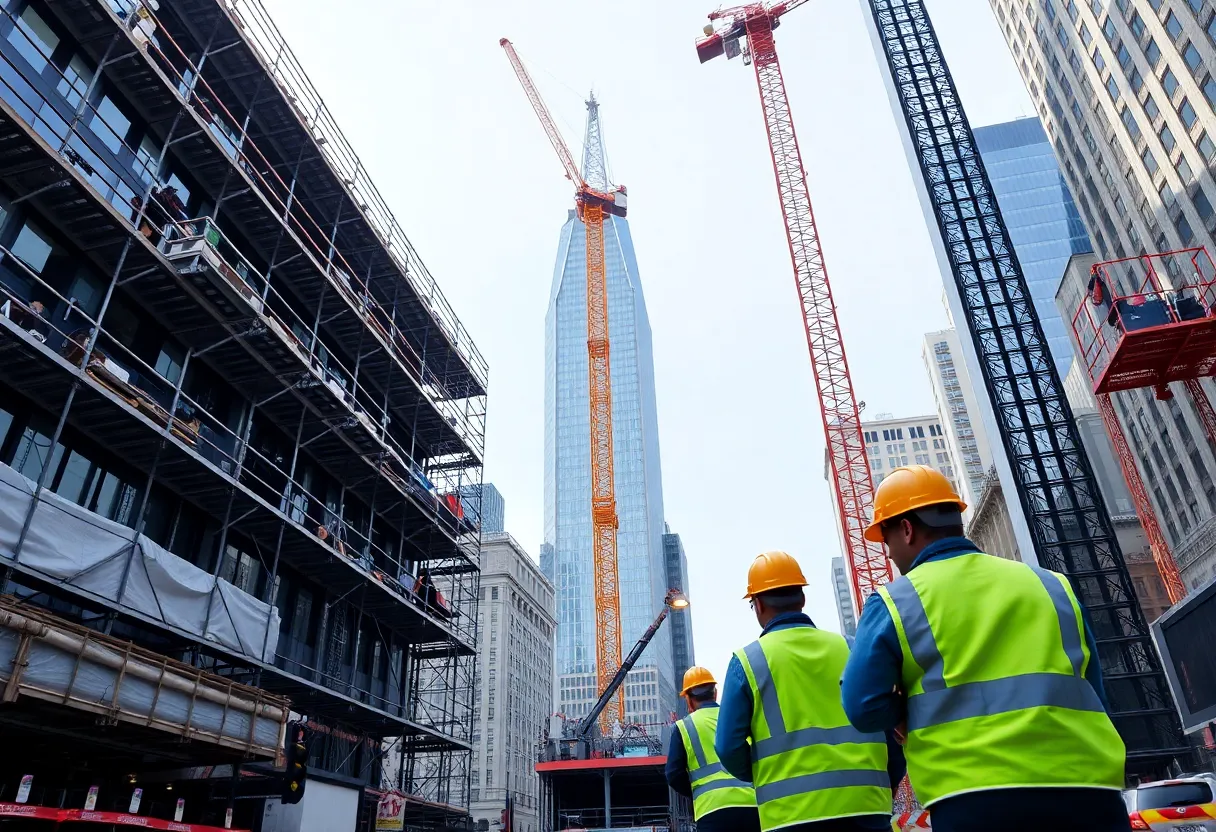
News Summary
A coalition of business and civic groups in New York is promoting a federal bill aimed at amending the Scaffold Law. Proposed by Representative Nick Langworthy, the bill seeks to eliminate federal funding for construction projects adhering to this longstanding regulation, which holds property owners liable for worker injuries. Supporters argue it could lead to significant cost savings, while opponents warn that changes may compromise worker safety. The ongoing debate highlights a clash between economic interests and labor protections within the state’s construction industry.
New York – A new coalition of business and civic groups in New York is advocating for a federal bill aiming to amend the Scaffold Law, a construction regulation that has been in place for 140 years. The coalition, organized by a former U.S. representative, seeks to prompt state lawmakers to consider changes to this longstanding legislation.
The proposed bill, put forward by Representative Nick Langworthy, a Republican from New York, intends to strip federal funding from any construction project in the state that adheres to the Scaffold Law. This critical legislation holds property owners and contractors absolutely liable for gravity-related injuries incurred on construction sites, regardless of whether the worker was negligent.
Langworthy asserts that repealing the Scaffold Law could result in substantial savings—potentially millions of dollars—in construction costs for essential projects, including schools and housing. The coalition argues that revisions to the law are necessary for a healthier construction environment and more efficient financial practices.
Opposition to the coalition’s proposal is strong, particularly from labor unions who claim that altering the Scaffold Law would undermine crucial safety protections for workers. They argue that the law serves as an essential safeguard at hazardous construction sites, maintaining a high standard for worker safety. Union leaders, including the President of the New York State AFL-CIO, have publicly criticized Langworthy, suggesting that he is jeopardizing the well-being of workers in his own state.
Originally enacted in 1885, the Scaffold Law places the burden of liability heavily on employers, making them financially accountable for injuries caused by falls, with few exceptions. At that time, federal workplace safety agencies did not exist, resulting in the law’s formation to enforce necessary safety measures in an evolving industrial landscape. Critics highlight that New York’s law imposes insurance costs on construction projects, estimating an increase of 10% in insurance premiums linked to the law’s stringent liability structures.
The coalition supporting the new bill includes prominent organizations such as the Business Council of New York State, the Real Estate Board of New York, and the Partnership for New York City. This alliance, known as Build More New York, is spearheaded by Faso, who previously introduced a similar bill to Congress in 2018. Their goal is to ensure that Langworthy’s legislation avoids the pitfalls of Faso’s earlier effort, which garnered Senate approval but failed in the House.
Research reveals that claims for bodily injury in New York were twelve times higher than in any other state, contributing to inflated settlement costs for workers. Proponents of the Scaffold Law argue that it effectively protects workers compared to other states, framing it as a critical component in contrasting safety standards. However, advocates for reform contend that adopting a comparative negligence standard could offer a more balanced approach to liability, thereby allowing for greater accountability among construction companies.
The implications of the proposed changes to the Scaffold Law primarily focus on projects that receive federal funding, but the potential reforms could resonate throughout New York’s construction industry, sparking broader changes. If successfully amended, the law might foster the creation of more construction jobs and lower overall costs in the long term.
Concerns remain among opponents of the proposed bill, who fear that modifying the liability standards could enable companies to shirk their responsibilities in ensuring safe work environments, potentially resulting in increased accidents and worker injuries on job sites. The New York State Building and Construction Trades Council has firmly opposed the bill, emphasizing the importance of the Scaffold Law for worker protection.
As debates unfold, Langworthy seeks to connect his initiative to broader bipartisan infrastructure legislation anticipated in the coming year, creating a possible vehicle for the proposed reforms. The broader conversation continues as business interests and labor protections vie for attention in discussions about the future of construction regulations in New York.
Deeper Dive: News & Info About This Topic
- Times Union: New York’s 140-Year-Old Worker Protection Law
- Wikipedia: Scaffold Law
- Construction Dive: New York Scaffold Law Change
- Encyclopedia Britannica: Construction Industry
- Newsday: Scaffold Law Liability
- Google Search: Scaffold Law New York
- Capitol Confidential: Hochul’s Pipeline
- Google Scholar: Scaffold Law Reform
- Insurance Business: New York Scaffold Liability Insurance
- Google News: New York Construction Liability